Humanity's farthest spacecraft Voyager 1 suddenly stops transmitting data to Earth
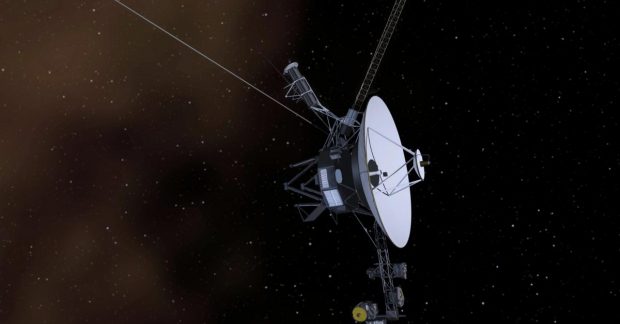
The legendary interstellar probe Voyager 1 has mysteriously stopped sending scientific and technical data back to Earth, though it continues emitting a carrier signal. NASA engineers warn that diagnostics will take time due to the unprecedented distance.
 💡Tech
Photo: UNIAN
Key points
- Voyager 1 stopped transmitting scientific data
- The probe continues to emit a carrier signal
- Troubleshooting is delayed by a 48-hour round-trip signal time
NASA's legendary spacecraft Voyager 1, which has been journeying through deep space for nearly half a century, has experienced a sudden and unexpected communication anomaly. Mission controllers detected that the probe stopped transmitting science and telemetry data to Earth, raising concerns among the engineering team. Despite the data outage, ground antennas are still receiving a carrier signal from the spacecraft.
According to flight engineers, the presence of the carrier signal indicates two positive factors: the spacecraft's high-gain antenna remains properly pointed at Earth and is fundamentally functional. The preliminary diagnosis suggests the issue lies within one of the onboard computers responsible for formatting scientific data before transmission. A similar technical glitch occurred last year, and the team successfully resolved it after careful troubleshooting.
Challenges of diagnosing issues at the edge of the solar system
Finding and fixing the root cause will take several weeks due to the immense distance involved. Currently, Voyager 1 is located approximately 26 billion kilometers away from Earth, travelling at a speed of nearly 61,000 kilometers per hour. Because a round-trip radio signal takes about 48 hours to reach the spacecraft and return, engineers must wait two full days for a response to every command.
Launched in 1977, Voyager 1 made history in 2012 by crossing the heliopause and entering interstellar space, becoming the first human-made object to do so. Its twin, Voyager 2, followed a similar path in 2018. Space scientists remain hopeful that diligent troubleshooting will restore normal operations to the historic explorer.
Source UNIAN — unian.ua/science/voyadzher-1-legendarniy-kosmichniy-aparat-nasa-per… ↗
Read next
 🇺🇦Ukraine
Tragedy in Afghanistan: School Explosion Results in Multiple Casualties
In Kunar province, an explosion at a school left 10 people dead, mostly children. The likely cause is identified as negligent storage of explosive materials nearby.
 🛡️Security
Army financing: why there is a shortage of funds for military payments
Experts explain the lack of funds for military salaries by delays in international aid and the need for urgent weapons purchases from the state budget.
 🛡️Security
23 more Ukrainians return from occupation: stories of rescuing vulnerable groups
The Ukrainian Parliament Commissioner for Human Rights, Dmytro Lubinets, announced the successful return of 23 citizens from temporarily occupied territories.
 🧠AI Analysis
Climate Change: Lightning strikes could double by 2100
Scientists predict a significant increase in the frequency of lightning strikes due to global warming, posing new risks to infrastructure and forests.
 🛡️Security
Night attack on Odesa: residential building damaged, casualties reported
Russian forces launched a drone strike on Odesa on the night of November 29, hitting a residential high-rise. Emergency services and an operational headquarters are provi…
 🛡️Security
Night attack on Odesa: residential building damaged, casualties reported
Russian forces struck Odesa on the night of November 29, damaging a high-rise residential building. Emergency services and an operational assistance headquarters are work…